The number of miles you drive each year is one of the biggest factors behind your car insurance premium. More time on the road means more chances of an accident, so drivers who rack up high annual mileage usually pay more for car insurance than people who barely drive. The good news: if you drive less than average, you may qualify for real savings.
How Annual Mileage Affects Car Insurance
When you apply for car insurance, one of the first questions is how many miles you drive per year. Your answer feeds directly into your rate, since insurers treat mileage as a stand-in for exposure: every mile is another mile where something can go wrong. It is one of the core factors that affect car insurance rates, alongside your driving record, vehicle, and where you live.
A commuter who drives 20,000 miles a year spends far more time in traffic than someone who drives 6,000. More hours behind the wheel means more exposure to bad weather, distracted drivers, and road hazards. So high-mileage drivers pay more and low-mileage drivers pay less, all else being equal.
Where you fall relative to the average matters. The average US driver logs roughly 13,000–15,000 miles a year. If your annual total sits well below that, you are in the group insurers consider lower risk — and many will cut your rate to reflect it.
Mileage Brackets and What They Mean for Your Rate
Most insurers sort drivers into mileage bands with differing cutoffs. Here is the general pattern:
| Annual mileage | Typical rate impact | What to know |
|---|---|---|
| Under 7,500 miles | Often the lowest tier, with low-mileage discounts available | Common for retirees, remote workers, and second-car drivers |
| 7,500–12,000 miles | Moderately lower than average | Light commuters and weekend drivers usually land here |
| 12,000–15,000 miles | Around average | This is the typical range most quotes are built around |
| Over 15,000 miles | Higher than average | Long commuters and road-warrior drivers pay a premium for the extra exposure |
| 20,000+ miles | Often the highest mileage tier | May be flagged for business or heavy commuting use |
These are general bands, not a promise from any particular insurer. When you shop around, ask each insurer where their breakpoints fall — a few thousand miles can be the difference between a discount tier and the standard rate.
Why More Miles Means Higher Premiums
Insurance pricing is built on probability. Insurers cannot predict whether you personally will crash this year, but they can estimate the odds for a large group of drivers with similar habits. The more miles in the group, the more claims the group files. Your premium is your share of that expected cost.
Exposure is the key concept
Exposure means time at risk: a driver doing 25,000 miles a year is on the road roughly four times as long as one doing 6,000, and meets more risky situations — more intersections, more merges, more nights driving home tired.
Mileage interacts with how you drive
High mileage can also hint at other risk factors. Long commutes often mean rush-hour driving — stop-and-go traffic and congested highways where fender-benders are common. Work-related driving may mean unfamiliar routes or night driving, which is why insurers also ask how you use the car: commuting versus pleasure use makes a difference.
It is not the only factor
Mileage never sets your rate alone. Your driving record affects insurance rates more dramatically than mileage does in most cases — a speeding ticket or an at-fault accident raises premiums far more than a few extra thousand miles. Mileage is one input among many, which is why two drivers with the same mileage can pay very different prices.
How Insurers Check Your Mileage
Some drivers are tempted to understate their mileage to get a lower quote. That is a mistake. Insurers have several ways to check, and a material misrepresentation on an application can cause a claim denial or a policy cancellation.
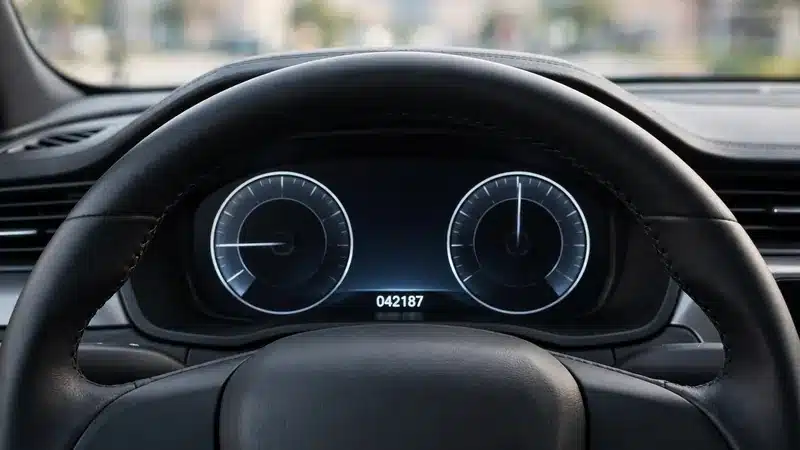
- Odometer readings at application and renewal. Some insurers ask for your current odometer reading and compare it to a later reading to calculate your actual annual miles.
- Previous policy data. When you switch insurers, your old insurer’s records may show your reported mileage history.
- Vehicle service records. Dealerships and repair shops often record odometer readings on invoices, which data aggregators can access.
- Inspection and registration records. Many states record mileage at inspection or registration, creating a public trail.
- Telematics programs. Usage-based programs track your miles directly through a phone app or plug-in device, removing any guesswork.
The safest approach is to report your mileage accurately. If you genuinely drive less than you estimated, tell your insurer — the adjustment could lower your bill at renewal.
Options If You Barely Drive
If you drive under 7,500 miles a year, a standard policy may not be your cheapest option. Two alternatives are worth a look:
Pay-per-mile insurance
Pay-per-mile car insurance charges a small base rate plus a per-mile fee, so light drivers often pay much less than they would on a traditional policy. These plans are designed for exactly this situation: the car’s monthly cost tracks your actual driving instead of an annual estimate.
Telematics and usage-based programs
Usage-based programs measure your real driving through an app or device, and safe, low-mileage driving earns discounts. Our guide to telematics insurance explains how these programs work and whether the monitoring trade-off is worth it.
Low-mileage discounts on standard policies
Many traditional insurers offer a low-mileage discount without any tracking device — you simply attest to your annual miles. If you have not told your insurer about a lifestyle change like retirement, remote work, or a shorter commute, it is worth asking whether a lower band now applies.
How to Estimate Your Annual Mileage
Accurate estimates start with real numbers, not guesses:
- Read your odometer now and write down the number. If you have an older reading (from a service receipt or a photo), note that too, along with the date.
- Do the commute math. Multiply your round-trip commute by the days you drive to work each year. A 30-mile round trip driven 220 days is 6,600 miles before you count a single errand.
- Add regular trips. Weekly errands, school runs, and weekend driving add up. Estimate your weekly non-commute miles and multiply by 52.
- Include road trips. Add any long drives you take in a typical year.
- Cross-check with history. If you have two odometer readings a year apart, the difference is your most reliable number — trust it over the math.
Revisit the estimate each year — a new job, a move, or a shift to remote work can change it dramatically.
Ways to Keep Your Mileage-Related Costs Down
- Update your mileage after life changes. Retirement, remote work, or a shorter commute can drop you into a lower band. Call your insurer rather than waiting for renewal.
- Consider a pay-per-mile policy if you consistently drive under 7,500 miles a year.
- Consolidate trips. Batching errands into one outing cuts both fuel costs and wear that shows up in mileage estimates.
- Look at the full discount picture. A low-mileage discount stacks with other savings — our guide to car insurance discounts covers the most common ones to ask about.
- Shop around with your real number. Since cutoffs differ by insurer, getting quotes with your actual annual mileage lets you compare honestly. Young drivers with light mileage can also see how mileage interacts with other factors in our look at car insurance rates at age 25.
Frequently Asked Questions
Do insurers really give discounts for low annual mileage?
Yes, many do. Drivers who log roughly 7,500–10,000 miles or fewer per year often qualify for a low-mileage discount on a standard policy, and some insurers offer pay-per-mile plans built specifically for light drivers. Ask your insurer where their mileage breakpoints fall.
What happens if I drive more miles than I told my insurer?
At renewal, your insurer may adjust your premium to match your actual mileage once it becomes clear from odometer readings or records. In more serious cases, deliberately understating mileage can be treated as misrepresentation, which can jeopardize a claim or lead to cancellation. Always report honestly.
How is annual mileage calculated if I just bought my car?
With no history to draw on, insurers rely on your estimate — usually your commute math plus expected errands and trips. Some will verify with an odometer reading after a few months. Keep a record of your reading when you buy the car so you can check the estimate later.
Does business driving count toward my annual mileage?
Yes. All miles count, including commuting and business use. Business use is usually rated separately and costs more than commuting or pleasure use, so tell your insurer if you drive for work rather than just to work.
Can telematics lower my rate if I drive a lot?
Possibly. Telematics programs score your driving behavior — smooth braking, gentle acceleration, safe speeds — as well as your miles. If you drive a lot but drive well, a usage-based program may still earn you a discount compared with a policy that prices you purely on mileage.
What to Do Next
Start by pulling your real number: read your odometer, do the commute math, and compare the result to the estimate on your current policy. If there is a gap — especially if you have switched to remote work or retired — call your insurer and ask whether a lower mileage band applies. Then get at least two fresh quotes with your accurate annual mileage, and include one pay-per-mile option if you drive under 7,500 miles. For a wider view of every input that shapes your premium, read our guide to what affects car insurance rates.
This article is for general educational purposes only and is not insurance, legal, or financial advice. Coverage rules and rates vary by state and insurer.