Yes, many US insurers offer a car safety features insurance discount when your vehicle comes equipped with factory-installed safety technology. Features like automatic emergency braking, blind-spot monitoring, and anti-lock brakes make collisions less likely, so insurers reward them with lower premiums. The savings are real but not always automatic, so it pays to know which features qualify and how to claim them.
Why Insurers Reward Safety Features
Car insurance is priced on risk. Every rate you are quoted reflects the insurer’s best estimate of how likely you are to file a claim and how expensive that claim might be. When your car carries technology that prevents crashes or reduces injuries, the insurer’s expected cost drops, and part of that savings comes back to you as a discount.
This is the same logic behind the broader guide to car insurance discounts: insurers reduce rates for drivers and vehicles that file fewer, smaller claims. Safety features are one of the clearest signals that a car is a lower risk to insure.
Safety Features That Commonly Earn a Discount
Not every gadget on a new car moves the needle, but several well-established features are widely recognized by insurers. If you are shopping for a vehicle, safety technology is worth weighing alongside sticker price and fuel economy, because the right features can lower your insurance costs for as long as you own the car. Here are the ones most likely to earn you a break.
Anti-lock brakes (ABS)
Anti-lock brakes prevent the wheels from locking during hard braking, which helps you keep steering control in a panic stop. ABS has been standard on most vehicles for years, so many policies build it into base rates automatically. It remains one of the most commonly recognized safety discounts in the industry.
Automatic emergency braking (AEB)
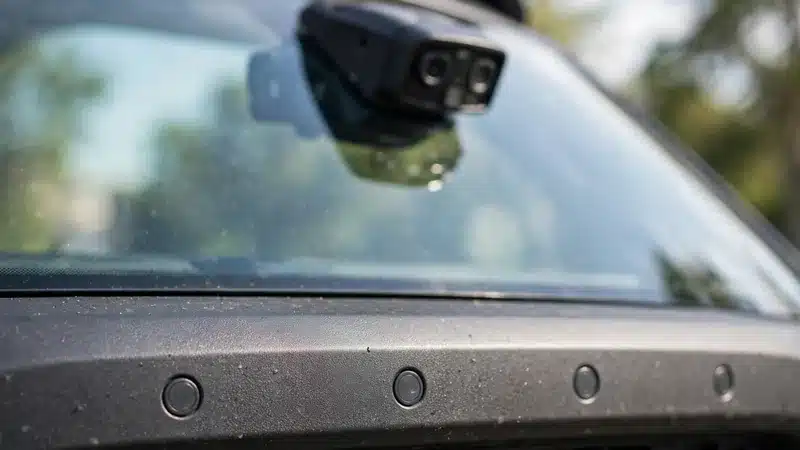
AEB uses cameras or radar to detect a possible collision ahead and applies the brakes if you don’t react in time. Because rear-end crashes are among the most common claim types, insurers view AEB favorably, and many list it explicitly among qualifying driver-assistance features.
Blind-spot monitoring
Blind-spot monitoring warns you when another vehicle is sitting where your mirrors can’t see it. This technology directly addresses lane-change collisions, so several insurers include it in their safety-feature discounts.
Rearview and surround-view cameras
Backup cameras are now required on new vehicles in the US, and they cut down on low-speed parking lot collisions. Insurers generally recognize factory-installed camera systems as a qualifying safety feature.
Electronic stability control
Electronic stability control helps keep the car on its intended path during skids and sharp maneuvers. Like ABS, it is standard on nearly all modern vehicles and is frequently part of safety discount programs.
Lane departure warning and lane-keeping assist
These systems warn you or gently steer you back if the car starts drifting out of its lane. They target run-off-road and sideswipe crashes, and many insurers count them toward a driver-assistance discount.
How the Safety Discount Works
Safety discounts typically apply per vehicle rather than per driver. If your household insures two cars and only one has advanced driver-assistance technology, the discount usually applies to that car’s premium only. The table below shows how different feature categories are generally treated.
| Feature category | What it helps prevent | Typical discount availability |
|---|---|---|
| Braking and stability (ABS, stability control) | Loss-of-control and skid crashes | Widely available; often built into base rates |
| Collision avoidance (AEB, forward-collision warning) | Front-end and rear-end collisions | Common among major insurers |
| Visibility aids (blind-spot monitoring, backup cameras) | Lane-change and parking collisions | Common; varies by insurer |
| Occupant protection (airbags, reinforced frames) | Injury severity when a crash happens | Widely available |
The size of any discount depends on the insurer, the state, and the rest of your risk profile. A safe car does not cancel out a poor driving record or high annual mileage, but it does nudge the price in your favor.
How to Claim Your Discount
Here is the frustrating part: many drivers own cars that qualify for a safety discount and never receive it, simply because the insurer’s records don’t list the features. Follow these steps to make sure you get credit.
- Check your window sticker. The Monroney label that came with the car lists factory-installed safety equipment. Keep a photo of it.
- Look up your VIN. A VIN lookup often shows the original equipment list, which serves as proof of factory-installed features.
- Ask your insurer directly. Call or message your agent and ask which safety features earn a discount on your policy. Mention each one by name.
- Review your declarations page. After any change, confirm the discount actually appears on your policy documents.
- Recheck when you shop. If you are comparing quotes, learn how to save on car insurance by asking every insurer the same safety-feature questions, since recognition varies.
What Safety Discounts Won’t Do
Safety features help, but they have limits. Aftermarket devices you install yourself, such as add-on backup cameras or third-party dash cams, generally do not qualify, because insurers cannot verify their quality or installation. Features also depreciate in value for rating purposes as cars age; a ten-year-old model with early stability control may receive less credit than a current model with a full driver-assistance suite.
Safety technology also cannot fix risky habits. Speeding tickets, at-fault accidents, and long commutes raise premiums regardless of what your car can do. For a different angle on lowering your rate through your own actions, see the defensive driving course insurance discount guide. Seasonal hazards matter too: our winter driving car insurance tips explain how to avoid the cold-weather claims that safety features alone can’t always prevent.
What to Do Next
Start by confirming which safety features your car has and whether your current insurer is crediting you for them. Then compare that against your other options: timing matters too, so check the best time of year to buy car insurance before you shop. And since safety is only one piece of the puzzle, look into how to protect your car from theft, which can prevent claims that have nothing to do with driving at all.
Frequently Asked Questions
Do all safety features lower my car insurance?
No. Insurers generally recognize well-established, factory-installed features like anti-lock brakes, automatic emergency braking, and airbags. Newer or less common technology may not yet be in an insurer’s rating program, so always ask which specific features qualify.
Do aftermarket safety features qualify for discounts?
Usually not. Most safety discounts apply to equipment installed by the manufacturer, because insurers can verify it through the VIN. Aftermarket additions are harder to verify and rarely earn the same credit.
How do I prove my car has these safety features?
Your original window sticker (Monroney label) and a VIN-based equipment lookup are the most common forms of proof. If the features don’t appear on your declarations page after you mention them, ask your insurer what documentation it needs.
Will the discount apply as soon as I report the features?
In most cases, yes. Once the insurer updates your vehicle information, the discount typically takes effect on your current or next billing cycle. If you are mid-term, ask whether it applies immediately or at renewal.
This article is for general educational purposes only and is not insurance, legal, or financial advice. Coverage rules and rates vary by state and insurer.