Proof of car insurance is any valid, current document that shows your vehicle is covered by an active policy — most commonly your insurance ID card, either the paper card in your glovebox or the digital version on your phone. If you are wondering what counts as proof of car insurance and where to keep it, keep reading: the rules are simple, but showing the wrong document at the wrong moment can cost you a fine.
Nearly every state requires you to carry proof of coverage in the vehicle and produce it on demand. Here is exactly what qualifies, where to store it, and what to do when you are asked for it.
What Counts as Proof of Car Insurance
Not every insurance document works as proof. The one that counts roadside is the document your insurer issues specifically for this purpose.
- Insurance ID card (paper): The wallet-size card your insurer mails or lets you print. This is the gold standard — accepted everywhere, no battery required.
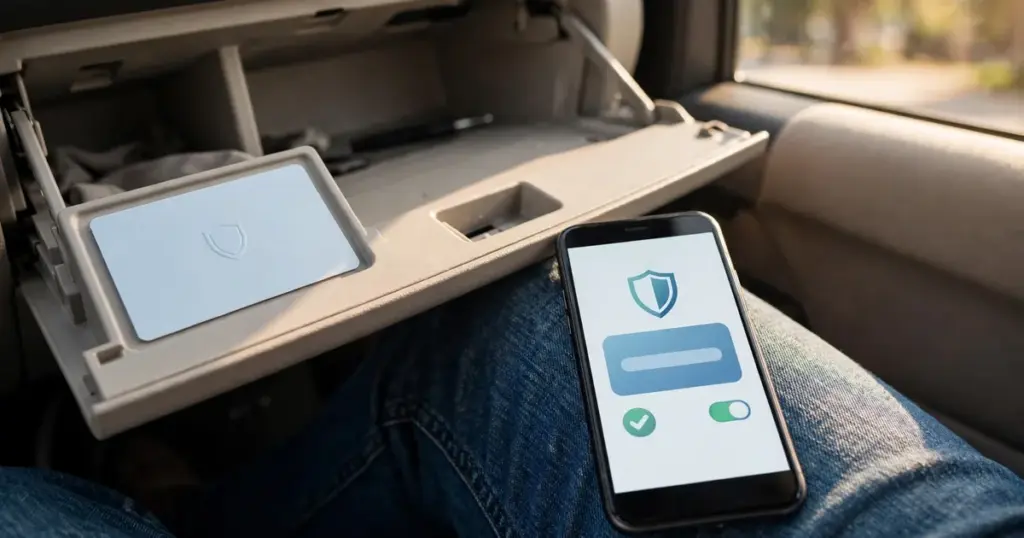
- Digital insurance ID card: The electronic card in your insurer’s app or mobile wallet. Most states now accept this at traffic stops and checkpoints, and it updates automatically when you renew.
- Temporary binder or new-policy confirmation: If you just bought a policy, a binder letter or confirmation email from your insurer can serve as proof until your cards arrive. Keep it with you during that window.
- SR-22 or FR-44 filing confirmation: If your state required you to file one of these, the filing itself is proof to the state — but you still carry your regular ID card in the car. See what an SR-22 filing requires if this applies to you.
What usually does NOT count
- A declarations page is long, detailed, and not designed for roadside use — officers generally want the ID card.
- Just knowing your policy number is not enough. Anyone can recite a number; proof has to be verifiable documentation.
- An expired card does not count, even if your policy renewed automatically. Officers go by the dates printed on the card.
What Your Proof Must Show
A valid insurance ID card typically lists the policyholder’s name, the policy number, the covered vehicles, and the policy’s effective and expiration dates. That date range is the part people get tripped up by: check it every time you renew, because insurers sometimes mail new cards late and the old one expires on paper before the new one arrives.
Your proof is tied to the vehicle, so it must match the car you are driving. If you recently bought a car and the card still shows your old one, ask your insurer for an updated card immediately — a mismatch can look like no coverage at all. This is part of the broader idea of proof of financial responsibility, which is what the law is really asking you to demonstrate.
Where to Keep Your Proof
The best place is wherever you can reach it fast, even when you are flustered. Most drivers keep it in two places at once — belt and suspenders.
| Storage method | Pros | Watch out for |
|---|---|---|
| Glovebox (paper card) | Always in the car; works with no battery or signal | Can expire unnoticed; replace at every renewal |
| Phone (insurer app or wallet) | Always updated; hard to lose | Dead battery or no signal at the wrong moment |
| Wallet (spare paper card) | Travels with you if you drive someone else’s car | Only covers you if the car’s own proof is missing |
| Email / cloud copy | Backup if everything else fails | Not accepted everywhere; keep it as a backup only |
A few practical habits make this effortless:
- Put a fresh card in every vehicle you own the day it arrives — and remove the expired one so the dates never confuse you.
- Download your insurer’s app and save the digital card to your phone’s wallet before you need it.
- Tell other drivers of your car (spouse, teen, roommate) where the proof is. The person behind the wheel is the one who gets asked.
- After any policy change — new car, new address, new insurer — confirm your proof reflects the change within a few days.
When You’ll Need to Show It
Proof of insurance comes up in a handful of predictable situations:
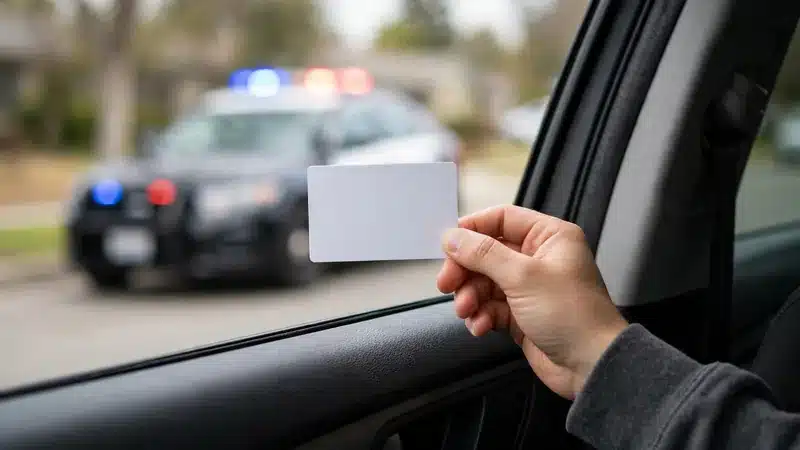
- Traffic stops: License, registration, and proof of insurance — the classic trio. Have it ready before the officer reaches your window.
- After an accident: You will exchange insurance information with the other driver and may need to show proof to responding officers.
- Registration and renewal: Many states verify coverage electronically when you register a vehicle or renew plates, which is one reason states track minimum coverage so closely.
- Checkpoints and inspections: Some states run insurance checkpoints or ask for proof during safety inspections.
- Renting or borrowing: A rental counter or a friend lending you a car may want to confirm you are covered.
Rules differ by state — some verify electronically and rarely ask for the card, while others still expect you to produce it. When in doubt, check with your state’s insurance department for the current requirements where you live. You can also review the state-by-state car insurance requirements to see how your state handles it.
What Happens If You Can’t Show Proof
Being unable to produce proof is treated seriously in most states, even if you are actually insured. Typical consequences include fines, and in some states your vehicle can be impounded or your registration suspended until you prove coverage. Repeat offenses get worse.
There is an important distinction here: not having insurance and not being able to prove it are usually separate violations, but both can cost you. If you are insured and simply left the card at home, some states let you present proof later to reduce or dismiss the ticket — but that varies, and it is never guaranteed. The penalty amounts and procedures differ by state, so confirm the specifics with your state’s insurance department rather than relying on general advice.
Frequently Asked Questions
Is a photo of my insurance card enough as proof?
Often yes, but not everywhere. A clear photo of a current card works in many situations, and most states accept electronic proof generally. But a photo is a backup — keep the official paper card or the insurer app’s digital card as your primary proof, since some officers prefer the original.
Does digital proof of insurance work in every state?
Most states now accept electronic proof of insurance shown on a phone. However, acceptance can vary by situation — for example, at registration offices or in court — so carry a paper card too. Check your state’s insurance department for the exact rules where you drive.
What if my insurance card expired yesterday but my policy renewed?
You could still be cited. Officers go by the dates on the card, not by your policy’s actual status. As soon as you renew, replace the card in your glovebox and update the digital version on your phone. If your insurer is slow mailing cards, print a temporary one from your online account.
Can I show proof from my insurer’s app instead of a card?
Yes, in most states. Insurer apps display an official digital ID card that carries the same weight as the paper version where electronic proof is accepted. Make sure you are logged in and the card is downloaded for offline access before you need it.
Do I need proof of insurance if I’m driving someone else’s car?
The car you are driving needs to be insured, and proof should be in that vehicle. If you borrow a car, check that its current insurance card is in the glovebox before you drive. Your own policy may extend to borrowed cars, but the proof that matters roadside belongs to the car.
What to Do Next
Take five minutes today: check the expiration date on the card in your glovebox, download your insurer’s app and save the digital card, and make sure every car you own has current proof in it. Then read up on proof of financial responsibility to understand the legal concept behind the card, and skim the state-by-state car insurance requirements so you know exactly what your state expects.
This article is for general educational purposes only and is not insurance, legal, or financial advice. Coverage rules and rates vary by state and insurer.